Thursday, August 13, 2015

SODA Story Goes...

This was one of the biggest milestones I've been wanting to get behind me since I started flying - my Medical Flight Test.  The day has arrived.  We're flying to KJVY to meet the FAA Airman Safety Inspector (ASI) who will be evaluating my performance to ensure my visual deficit is not a factor in my abilities.  There are two possible outcomes:  Satisfactory or Unsatisfactory.

This will be a slightly long post as it is really three flights in one.

I arrived at the airport Thursday morning just a few minutes earlier than planned, and ahead of Randy.  After the DCFS rampie buzzed me in, I proceeded to set up my headset and The Equalizer, then grabbed the checklist and completed as much of the preflight as I could while she was still inside.  I looked out the open hangar door and noted the patchy fog surrounding the field.  This doesn't bode well for my VFR cross-country, but it's an hour before takeoff so I make a mental note & keep going.

As I finished up Randy came in & we headed upstairs to complete the flight plan & nav log with the latest weather.  Once we finished filling out both, I called FSS to file the flight plan & get a standard weather briefing.  Conditions were forecast to be IFR for part of my route, but PIREPS were reporting VFR across the board except in the area around KHNB.

We headed out to the ramp where I completed my preflight, climbed in, and started setting up for the trip.  With my kneeboard in place, I dialed in the various COM & NAV frequencies I would need.  Once complete, we checked the AWOS, which was reporting 5nm visibility - enough to get out of here VFR.  We checked the brakes and I quickly made my radio call (5 min past filed departure time, we need to move) and taxied to 27.

Once off, I began trying to focus on flying airspeeds and headings while adjusting to having my information strapped to my leg.  I've done this hundreds of times in a simulator, but I always had everything laid out on my desk or on my iPad, so it was a huge adjustment & quite frankly I felt completely uncoordinated & out of my element.

 Once I got somewhat adjusted and relaxed in the cockpit, the flight was pretty straightforward.  About 35 min in the air and we were descending on KJVY.  There was some airliner traffic ahead, inbound to KSDF about 10 miles to the south.  I made note of the traffic and prepared for possible wake turbulence about the time we arrived at the airport.  There was some, it was mild, but very manageable.

Once we landed at KJVY we taxied to Honaker Aviation, shut down, parked, and I took my gear in.  We greeted the ASE who was waiting for us just inside, then headed to the pilot lounge to brief the flight and verify my information.

After some nervous tension regarding the aircraft registration, all our information was confirmed & it was time to fly.  Randy remained in the lobby, and the ASI walked with me to the plane. I did my standard pre-flight walk-around while he asked me a few questions.  I gave my best passenger briefing then proceeded with startup, followed by taxi to 18.

After run-up I pulled to the hold short and waited for a Mooney doing pattern work to climb out and turn, then made my takeoff call.  We climbed out and joined the downwind leg, then exited to the North, climbing to 3,500.

After tuning a few frequencies on NAV & COM, he asked me what the CTAF was for a certain airport he named & pointed out on the sectional, which was 123.0.  He then had me do a turn to the right and check ATIS for another field at the same time.  Then the moment of truth came.  "Ok, I'm going to simulate an engine out.  I'll gradually pull the power back."  I gave the trim wheel a couple spins up-aileron, pitched for 65 kts, then began finding us a field to make an emergency landing.  I found one at our 9 o-clock, but a little close.  I slipped to lose a little altitude, explaining as I did, and that I didn't want to lose too much.

As we got closer to the field, I noticed power lines across the middle (one of the things I needed to demonstrate, the ability to see obstructions in my chosen field if they were present).  I looked to the left and saw a better field almost immediately and announced the change.  Still a little high, I adjusted and added flaps slowly, then began my final descent to the field.

About 700 ft from the ground, he called, "Ok, go around."  Carb heat in, flaps 20, full power, airspeed returning, flaps up.  "Ok, great.  Climb us up to 1500ft, then head back to Clark County.  We'll join the 45° left downwind, runway 18."

About 2 miles from the field we heard another plane call they were entering the 45 and agreed we'd need to keep an eye out for him.  ASI saw it first, asked me if I did.  At first I couldn't.  Then he gave me visual cues where to look and I spotted him, about 4 miles away from us, passing diagonal left to right.

I flew about a mile further, checked for traffic, then made my turn toward the 45, making my radio call.  I entered downwind, then left base, making my radio calls & adding flaps accordingly.  After visually clearing the final approach, I made my turn and my radio call.  I added the last 10° of flaps just before short final and pitched for 65 knots.   I rounded out, let her settle down, flared, and put it down, a little firmly, but right on the center line.  I turned off the first available taxiway, stopped past the hold short, and called clear of the active.  I finished the post-landing section of the checklist, then began taxiing back to Honaker.

"That was a 'Satisfactory' by the way."

"Excellent, thanks!"

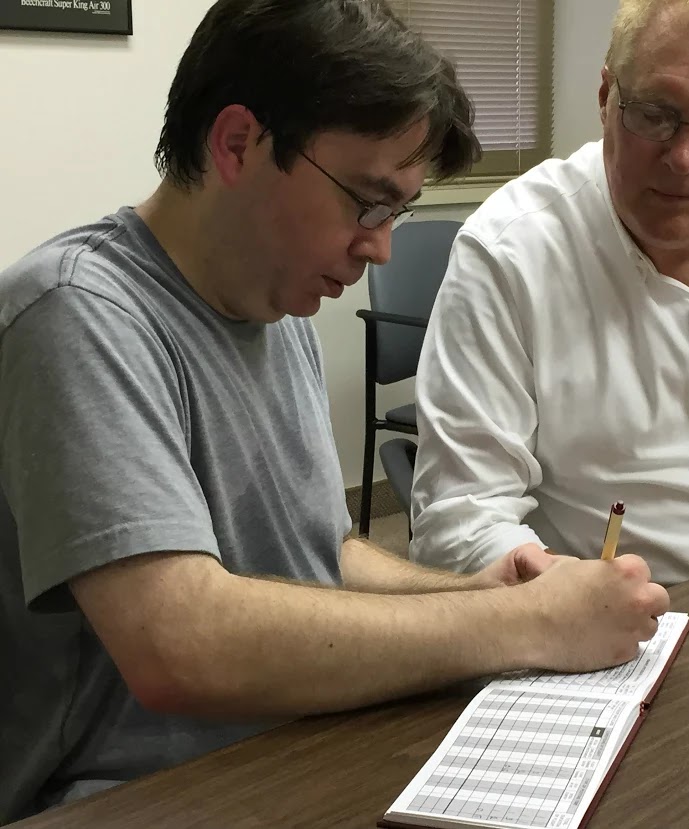
We taxied back & shut down, then headed back into the FBO.  He advised Randy immediately of my result, then we headed back into the lounge to debrief.  He had a few words of advice regarding operations in a multi-runway environment, as well as using a checklist during an emergency, but otherwise complimented my piloting skills and my professional demeanor on the radio (thanks PilotEdge).  He assured me the paperwork would be complete on his end by end of day and submitted to CAMI, who will then mail me the Statement of Demonstrated Ability (SODA) waiver.

We finished the debrief, then had some general discussion & casual conversation about flying between the three of us.  He then left, and it was time for Randy and I to finish planning the trip back to KHNB.

With planning complete, we headed back to 34Q and began the checklist.  The wind had kicked up a little, and traffic was now using runway 36.  Preflight, runup, and takeoff were good.  We departed the pattern to the Southwest, then began timing our waypoints.

The flight back was good, though choppy pretty much the whole way home.   Scattered clouds at 4500 AGL, which was 500 above our flight altitude, were the main factor in the turbulence.  I hit all the waypoints within 1-2 minutes of plan, then began my descent to KHNB.  I'd noted about 30 miles out that the radio calls indicated pilots were landing on 27 and planned to enter the pattern accordingly.

I entered a midfield crosswind for 27, joined the downwind, then base & final with flaps accordingly.  Then I apparently checked out & went somewhere else for a few seconds.  About the time I should have been rounding out, I hear Randy say, "Whoah!"  He pulled the yoke, after which I did as well, causing a little ballooning.

"Just let her settle down.  Man, you just about hit.  Wow.  Glad that happened while I was in here with you."  I salvaged a decent landing out of it, taxied clear & made my radio call.  I still do not know what happened, but I will be sure it doesn't again.

We parked by the pumps so the rampie could refuel her, got out & collected our gear.  After refueling was complete we pushed her back in the hangar, then grabbed some towels & proceeded to wipe off the bugs we collected.  After that it was upstairs for the debrief.

The dominant item of the debrief was naturally the test.  I filled Randy in on the details of what ASI had me do.  But mostly, I knew this had been weighing on me since I started flying, but I had no idea how much.  It's like ten tons of weight has come off my shoulders.  I've been more relaxed the past few days than I have been in years.  The cross-country portion of the flight didn't stress me nearly as much as I expected it to.  All-in-all, I logged 1.9 hours cross-country, and an additional 0.6 as PIC during the test.

We finished debrief, then scheduled my next flight, a cross-country to KCUL, for Tuesday.  Initial forecasts were for 50% rain chances, but the outlook has changed to VFR for the route.  We're meeting at 1800 local, so we should have plenty of sunlight right in our eyes as KCUL is WSW at a heading of 262.  Sunglasses will definitely be on the checklist.

Two Victor Uniform, clear of Two Seven.


Thursday, August 6, 2015

Teaching an Old Dog New Tricks

("Old dog" referring to my age, not my time as a pilot here)

It's been a busy week for me as far as flying goes - for the first time in almost a year I got two flights in.  Monday was the first.  Already different from the norm in that I usually fly on Tuesdays, this would be a flight that would stretch me, and also teach me some valuable skills with regards to landing an airplane.

Monday, 8/3  I'll skip the uneventful account of preflight & run-up and go straight to saying that my first landing was a little flat.  On climbout, Randy informed me that, "We're going to break you of that.  I'm going to teach you something new tonight - we're going to work on soft field takeoffs and landings."

"Cool," I thought.  Something new.  I should point out, with the way my flying hours have shaken out this year (that's my positive way of saying "thanks to all the horrendous delays"), it's been several months since I've done any maneuvers that have required full elevator deflection.  I'm not muscular in any sense, and I don't work out, well, except when I'm in the cockpit.  

We taxied straight back to good ol' Two-Seven, and as we approach the run-up area, he pulls the yoke back full and says, "The maneuver begins now."  We don't stop at the hold short, rather just make our takeoff radio call and taxi straight out.  I have hands on the controls but Randy has the plane, and I advance the power to full.

Now, let me tell you, if you've never experienced a soft field takeoff before, and I hadn't, it really throws you.  The idea is that you're taking off from a soft runway, let's say by deduction it's a grass strip, and it's recently rained.  You want to transfer the weight of the airplane off the landing gear as quickly as possible, beginning with the nose gear, so it doesn't sink into the ground and dig in, resulting in what John King would describe as "a bad day."  Adding full back yoke, the nose comes up almost immediately, but you have to keep it just a little off the runway, you don't want to let it to continue rising.  To accomplish this, you must gradually relax back pressure on the yoke.  The entire process basically results in the aircraft doing a wheelie down the runway, which is strange yet incredibly fun.  Steering with the rudder pedals and holding the nose at a certain height requires intense concentration and coordination between your brain, hands, and feet.  I love it.

At around 40 kts, the main gear then leaves the runway, thanks to ground effect, which I'll let you research for yourself on Google/etc., but in short it's caused by the air coming around the end of the wingtips.  This lifts the plane in the air below stall speed.  If you come out of ground effect before you have enough airspeed, the wings will stall, and the plane will dive nose-first into the runway.  So, you have to continue to hold the yoke forward a bit to keep the plane in level flight, about 10-15 feet above the runway, until airspeed is sufficient to leave ground effect.  This part threw me, because it feels unnatural at first.

Once we were in the air and on downwind, Randy began briefing me on the soft field landing technique, which is really the same as a regular landing, but upon touchdown, you again hold the nose gear a few inches off the runway, until all the airspeed bleeds off.  This forces you to come in at a more precise angle in your approach, and more importantly ensures you  time your round out and flare such that you are able to hold the nose off on landing.

We did 7 soft field takeoffs and landings.  I had one really good one, the rest were not so great, but I understood the concept and was picking it up.  We taxied back after the seventh landing and I handed 34Q over to the next student in line, who was waiting at the ramp to work on night flights with Randy.  A quick debrief, and then planning the next flight.  Weather for Wednesday was supposed to be 50/50 rain chances, thunderstorms possible, but we scheduled for 6:30 PM with the hopes of getting a few landings in anyway.

Wednesday, 8/5   I was still at the office around 4:50, discussing an issue with our lead developer, when my cell phone rang.  It was Randy, and I assumed he was calling to cancel due to the weather looking questionable.  However, he advised we might have a window to get some landings in if I could get to the airport soon.  So, I finished up my conversation, grabbed my headset from beside my desk, and headed for the door.  I always keep my gear - My flight bag, my headset, and "The Equalizer," in my car on flight day rather than having to head home to get them after work, for just this reason.  I then bring my headset into my office to keep it out of the heat/cold.

I arrived at KHNB around 5:20.  On the way in I was looking at the sky & calling the AWOS on my phone.  Conditions were VFR currently, but I wasn't so sure it would stay that way long enough.  We discussed it, looked at the radar, and decided we had time for at least 5 or 6 landings, which actually turned into 10.

Skipping the run-up/etc again, tonight's agenda was again soft field landings.  Wind was favoring Niner I did much better with almost all of them, though I had a couple unstable approaches that resulted in touch-and-gos and go-arounds.

After about 5 landings, as we were abeam touchdown for the sixth, he pulls the power and says, "Alright, you just lost your engine.  Get us back to the airport, soft field landing.  This is what you'd do if you were putting it down in a field during an emergency."

I flew my airspeeds just as I would in a normal pattern,  but turning the plane back towards the end of Niner instead of flying a standard base leg.  Once I knew we had the runway, I began adding flaps.  I added them a little late, which resulted in rounding out just little far down the runway, but I then continued with a normal landing as I held it off, flared, then touched down and held the nose off the runway.  "Excellent job.  Let's keep going, full power."

After the 8th landing, as we taxied back to Niner, he advised this would be the last one.  He wanted to show me one more new thing - short field takeoffs and landings.

We taxied to the end of the runway, ensuring we used every available inch.  I held the brakes, advanced the power to full, checked engine instruments, and released the brakes.  At 60 knots I rotated, and then held the airspeed at Vx of 64 knots until we were at least 50 feet off the ground, then rotated to Vy of 78 kts for a normal climb during the remainder of the climbout

On downwind we briefed the short field landing.  We'd be coming in a little high, my aiming point would be the 500' markers, and my touchdown point would be the 1,000' markers, landing no further than 200' past the beginning of the marker.  I set up the approach, brought it in, rounded out, and touched down just beyond the end of the 1,000' mark.  "Great job, excellent!  That was so good, let's do another.  Full power."  On climbout he changed his mind.  "You know what?  This time, you land the plane however you want.  If you want to do a normal landing, go ahead."  I didn't hesitate.  "I'll do a soft field."  "Ok, great!"

The approach was good, right on glide slope, rounded it out, corrected for a slight balloon, held it off & flared it.  Touchdown was smooth, on center, and I just held the nose up, slowly applying more back pressure on the yoke until it was all the way back & the stall horn was singing.  "Yes, you got it!    That's what I want to see."  

We taxied back & put 34Q away for the evening, went into the office & debriefed.  I advised I'd made the decision to do my medical flight test separately, ahead of the checkride, just to get it done so it wouldn't be a factor in the rest of my training, or my checkride itself.  If they want to do the MFT at Bowman Field in Louisville or at Clark County airport, we'll just schedule that to be a cross country flight and nail two birds with one stone & get the most for my money on the flight.

The CFI from the FSDO that I was planning to fly with on the checkride/flight test is out of the office for a couple weeks, so I have a call in & waiting on a call back from his supervisor to begin scheduling the test (have to coordinate with my CFI & ensure the plane is available).  No plans to fly next week pending the callback from the FSDO.  I'll post details here as I get them.

Until then, Two Victor Uniform, clear of Two Seven.

Tuesday, July 28, 2015

July 28, 2015 - A Day I Will Never Forget

"Oh! I have slipped the surly bonds of Earth
And danced the skies on laughter-silvered wings;
Sunward I’ve climbed, and joined the tumbling mirth
of sun-split clouds, — and done a hundred things
You have not dreamed of — wheeled and soared and swung
High in the sunlit silence. Hov’ring there,
I’ve chased the shouting wind along, and flung
My eager craft through footless halls of air...."
- John Gillespie Magee, Jr., "High Flight"

There was something in the air this day, I felt it from the moment I woke up.  I knew, and even told a coworker when he asked if this would be "the flight," "Yes, I'm saying it.  Today is the day."

It was hot.  Africa hot.  Tarzan couldn't stand this kind of hot.  As I drove to the airport, I watched a roadside digital sign tick from 94 to 95°F.  With the humidity, the heat index was 105°F according to the Yahoo! Weather App before I left .

I did my pre-flight walkaround, noting the weak piece of plastic around the fuel drain on the right wing was starting to split to the aft.  Other than that, N9634Q looked more beautiful than she ever did.  Randy and I talked a little about other pilots' mistakes, discussing the scenario first & what I would do, followed by the pilot's choice and the very unfavorable outcome.  We finished our discussion as the KingAir taxied to the runway, then climbed in the cockpit and started the rest of the checklist.

About halfway through my briefing, etc, he advised me to go ahead and get it started. "I know you know how to do the briefing.  You've done it since your second flight.  Not trying to rush you, let's just get it started.  No need to set up the GPS, we're just going to work on landings."

AWOS said winds were straight down the runway at 5, but all three wind socks said otherwise, which wasn't really a concern since they felt lighter than 5 knots.

Startup, taxi, runup were all normal, though whether or not the landing light was working is still up in the air.  I called my takeoff, then brought 34Q around through the pattern and set up on final, calling that it would be a full stop. It was one of my better landings.  We taxied clear of the runway then headed back out.  "Alright, you give me two more landings like that and we're going to solo you tonight."

Landing 2 wasn't as good.  I carried too much speed, even after touchdown.  "Alright let's just go around, full power."  Cleaned it up, started climbout, then called that I was touch-and-go for Two Seven.

Landing 3 was as good as the first.  As I exited the runway I was expecting him to want one more good one.  "Alright, take me back to the hangar, and I need to see your logbook and your medical."

An RV8 getting ready to depart asked over the radio if we were done.  Randy advised I was getting ready to solo, and the RV pilot (same one I met after an earlier lesson) said he'd go flying to the north to give me plenty of time.

We taxied off to the side of the ramp away from the pumps.  He reached into the back seat and got my flight bag.  I handed him my logbook, then my medical for the appropriate endorsements.  We had to move toward the taxiway to make way for N177JE (Citation), then he finished writing, I put everything back in my flight bag, and he climbed out.

I expected this moment to be filled with nervousness, anxiety, and tension.  But it wasn't.  I'd done this hundreds of times by myself at home, both in X-Plane and FSX/P3D.  The one thing that did concern me was the storm clouds that appeared to be building to the Northeast.  I couldn't tell if they were getting closer or moving away.

I taxied to Two Seven just as I had done dozens of times with Randy, stopped at the hold short, checked final approach, then made my radio call.  Deep breath.  "Moment of truth, right here" I said out loud to myself.  I taxied out onto the centerline, then advanced the throttle to full,

With less weight in the plane, and a new engine, she accelerated quickly, and was ready to fly in no time.  I lifted off and began my climbout.  The first solo trip around the pattern was uneventful to be honest.  That's not to say it was boring, but it was cut-and-dry.  I lined up on final, made my full-stop radio call, and set her down for one of my best landings so far.   As before, the plan was to do three full-stop landings.  I taxied back, and repeated the pattern.

Landing #2 was much less graceful, but I thought I had it under control.  I bounced.  Not hard, but high (looking back I suspect I had help from a wind gust); high enough that I didn't feel comfortable continuing the landing, so I added some power to stay up, retracted the flaps, then added full power and called my go-around.  I did everything else as usual and didn't even worry about not getting a good landing.

Landing #3 was back on-point.  As I taxied off the runway Randy called over the radio and asked how the weather looked to the East.  I responded that it was very cloudy.  He'd been watching the weather and the radar, and said I should have time for one more if I felt like it.  "Sure, I'm up for one more."  I taxied back to Two-Seven, made my call, and started down the runway.

As soon as I got in the air, I was questioning my decision for a few moments.  Due South of the airport, about 10-15 miles, was a dark bank of clouds and what appeared to be rain.  I looked for a second, also glancing back to the Southeast, then continued my climbout, just as I had done over a hundred times before.  I visually checked the clouds on downwind, but otherwise did everything just as I always had, no rushing, no pressure, just fly the plane.  As I made my call on final, the RV8 called that he'd be entering midfield crosswind.

The fourth and final landing of the evening was probably the best.  Everything I did looked and felt better than it had the other six times to me.  I taxied off the runway, past the hold short, and called that 34Q was "clear of Two-Seven for the evening."  The RV8 pilot offered his congrats over the radio, I thanked him, completed the post-landing part of the checklist, and started taxiing back to the hangar.

It was at this very moment it sank in what I had just done.  The minute I started rolling after post-landing, I could not control the huge grin that came across my face.

I'd finally arrived.  After years of dreaming, hoping, waiting, wondering if it would ever happen, I just flew, and landed, myself, with no one else in the plane.

I taxied 34Q back to the DCFS hangar.  Randy and his wife were there - she had been taking pictures.  He pretended to marshal me in, then I turned her around and set her up so we could push back into the hangar.  I proceeded with shutdown, took off my headset & seat belts, climbed out and shook Randy's hand.  I had to give him a hard time.  "Randy, no offense, but she flies a lot better without you in there."  We had a good laugh, then took some pics with the plane before putting it in the hangar.


The RV8 owner taxied over to get fuel, and to congratulate me.  "You've just opened up a whole new world of possibilities," he said as he shook my hand.  "Welcome, it's great to have you."

We went upstairs to the classroom for the ceremonial cutting of my shirt tail.  Unfortunately due to the heat, my shirt was too soaked to write on, so he will write all the details this week and have it ready by my next lesson.


As he cut my shirt, I couldn't help but think about the last year, and how I felt after that first flight, knowing this was the time to do this.  All the delays, all the frustrations, every setback was gone in that moment, not even on my mind anymore.  Afterward I also got the joy of adding my first entry into my logbook for PIC/solo time, 0.8 hrs worth.


"You've just done something that very few people ever get the chance to do.  You left the earth, in a machine, by yourself.  There's only 300,000 or so of us in the world right now, out of how many billion?  That's something special."  Indeed it is.  It's all I've been able to think about the last two days.

Next Monday will be another supervised solo, two landings with Randy, two or three by myself.  Then after we put the plane away, it's upstairs to plan the first cross country flight, with the intention of flying the cross country during the following lesson.

I expect to have my checkride scheduled by the end of August, though I have contingencies planned for the Medical Flight Test portion if it looks like I won't get it in before my authorization runs out.  I'm no longer stressed about that part, I'll just take care of it separately if it comes down to it.

It's happening, and it's happening quickly.   If all goes as it appears it will, I should be getting ready for my checkride this time next month.  No doubt I'll be FULL of anxiety and nervousness for that flight.

Two Victor Uniform, clear of Two Seven.


Thursday, July 23, 2015

Over the River

After another, long, multi-week delay, I finally got back in the air Tuesday evening.  Yes, the engine was back in the plane two weeks ago.  However, contrary to what my CFI and I understood, it was a brand new engine that had to be broken in.  The first 4 hours on the engine have to be cross-country flight.  Not that big a deal, right?  If everything goes right, it's not.  Since when has anything about these delays gone as expected though?  Long story short, on the evening of 7/13 during the cross country the alternator gave up the ghost.  Yes, the same alternator that failed on me last fall, supposedly due to a loose wire on the inside.

Enough about the delays.  They're behind me (us - there are 5 of us 'leftovers' from last summer that still need to finish up).  I do my walk-around while he fuels her up, explaining the extra weight will add a little stability in the 9-15kt winds.

First order of business after the runup is setting the OWB VOR.  I'm to track a radial to it once we get airborne and fly to it, or toward it at least.  I do so, adjusting along the way for the wind & relatively close proximity of the VOR - it's about a 20 minute trip to KOWB from KHNB.  I used to be proficient in this back in my early flight simming days, but I don't do it much anymore since most of the planes in-sim, especially X-Plane, contain a G430 or comparable GPS simulation.  I also need to work on identifying the VOR code, which will be easier when I have the chart in-hand during an actual cross-country (I'll use ForeFlight once I get my PPL, but the same applies).

Once we get close to the river, he tunes COM1 and has me turn east, toward KY8, which is Hancock County.  Terrible name for an airport anyway.  When you're used to doing radio calls for Huntingburg Airport it's even worse.  I make calls for many other airports while flying on the PilotEdge network, but apparently my speech muscle memory from doing so didn't come along for this flight.  Each time I called "Hancock County traffic...." it was a struggle just to enunciate clearly.

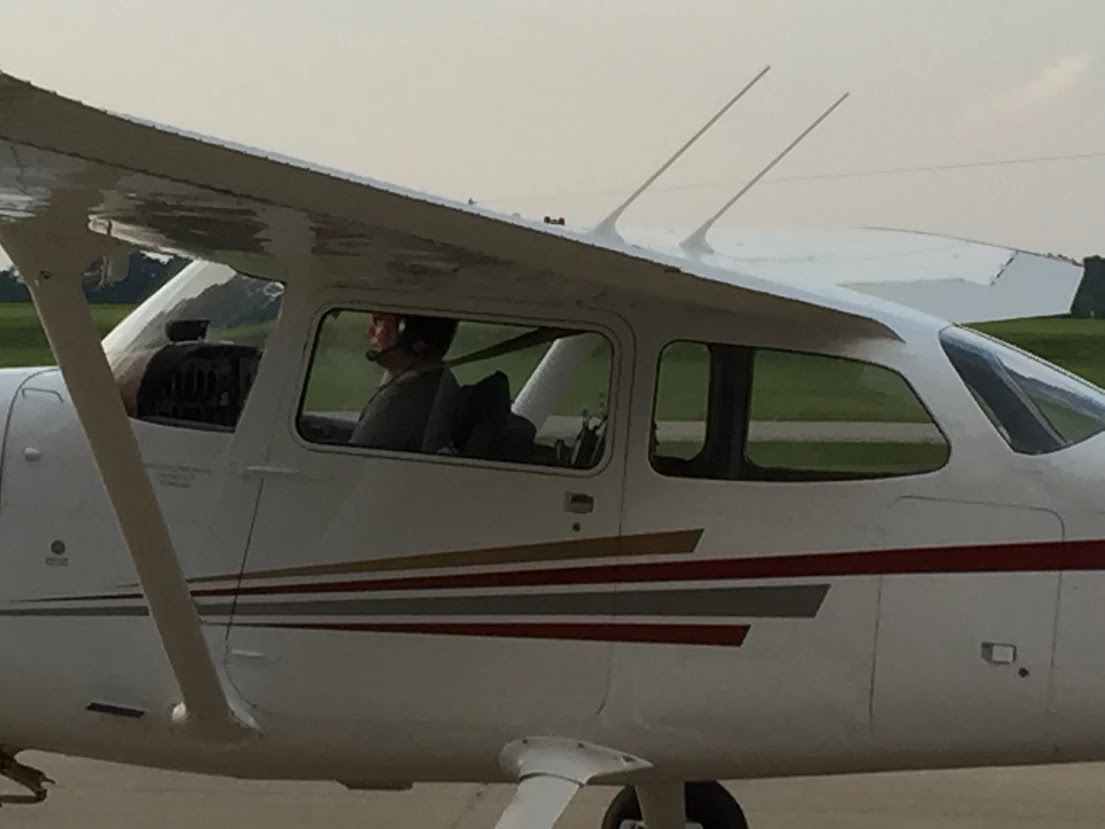
I turned right onto the 45° left downwind for runway 5.  Pattern altitude at KY8 is 1400'.  Good.  I have to put the altimeter needle somewhere else and need to use my brain, even if just a little, to know when I'm 500' above to start my turn to final and crosswind turn on climbout.  This was my first landing in 2 months, and my first at any other airport.  I set it down right on center, no ballooning, no awkward over-correcting, just a good landing.  "Alright, let's do another one."  The second looked about the same as the first, and we were off again.

"Alright, fly a heading of 280, put 019 in the OBS, intercept that radial, and take me back to Huntingburg."   I got us on the radial, and he made sure the GPS wasn't showing me where KHNB was.  It was a hazy day, so it took me a bit to see the field, probably 15 miles out, but I could make out the airport clearly.    I was set up perfectly to enter the 45° left downwind for 27.  Made the radio call, then started my descent from pattern altitude once I was abeam touchdown.

I won't sugar coat it.  The first approach to 27 was a flat-out ugly, over-correcting, bumbling mess, and as a result, the landing was terrible.  We talked it through on climb-out & laughed about it. "Randy, I can do way better than that."  "I know you can."  "Yeah but let me prove it to you."  "Well, you did land the airplane though."  "True, but it wasn't pretty."

He checked the crosswinds again.  7 kts, straight across the runway.  I said, "Good, I need that."  As we approached abeam, I loosened up & got relaxed, and half-jokingly said "Randy, let me show you how I do this at home.  Which is really the same way I would do it here, but let me just translate it into the real thing."  I did.  And it was great.  A little flat, but I was loose, calm, inputting small corrections, right down the middle.  I did one other landing just as good, and he said, "Alright, let's stop there.  I don't want to beat it to death," meaning I had a good thing going and was on point, and he wanted to end the flight on a good note.

As we taxied back to the hangar, he complimented that it was the best I'd ever flown with him, and he honestly couldn't tell the difference between me and any of his friends who have been certificated pilots for years.  I was humbled to say the least, and replied with appreciation for the encouragement.

As we put 34Q away I noticed some nearly-evaporated wet spots on the ramp near the pumps.  "Looks like we had some traffic while we were gone.  Looks like they stopped for some fuel"  He agreed, & said we'd probably have a lot this week with folks heading up to Oshkosh.

Then he told me he and his wife had planned on going this year for their vacation, but he just didn't have the heart to make me and the other four guys wait another week to fly.  So, they were leaving later this week for an extended weekend vacation elsewhere.  I told him I'd have understood if he'd have gone.  I'd have been sick knowing where he was - before all the delays, I was planning to go as my first big thing to do after getting my PPL - but I'd have understood.

Plans are to fly again next Tuesday, weather permitting of course.  Solo is back on the agenda, and it'll be happening soon.  Very soon.

The next day I went back across the river into Kentucky.  This time was by car, and my destination was KLOU - Bowman Field, where there is a CATS testing center.  I took and subsequently passed the written knowledge test.  I missed 13 out of the 60, but fortunately the printed report tells me exactly where in the regs I can find the ones that I missed.  I'll definitely review them before the oral test/checkride, in case the CFI testing me happens to bring them up.

It's getting closer, and I can almost see the finish line.  I'm getting excited again, the way I was when I first started flying.

Two Victor Uniform, clear of Two Seven.


Friday, June 26, 2015

This Old "Thing"

"No. I, um... I can't go in this. It's, uh... It's broken..."

"No, it's not broken, it's being maintained."
- Six Days, Seven Nights

Got a call from my CFI Monday morning. You guessed it. The plane is still down. Or, well, actually, down again. Seems the new engine was installed, everything was looking good. Then they recalled the engine, something related to the cylinders. DCFS had to pull the engine and ship it back. According to him they were expecting it back at KHNB by this Thursday. 

So, we decided to meet at the airport Tuesday evening anyway and work on prepping for the oral exam portion of my checkride. Yes, it's actually that close. Just have to finish up solo, cross-country, nail down all the flight requirements. 

Well, we both had a pleasant surprise - the new engine was already back, hanging on the hoist, supported by a dolly, with seemingly everything necessary attached. This means it will only be a day or so and 34Q will be flying again. This should be the last major delay from a plane standpoint. 

We spent about 2 hours doing a mock exam & discussing my incorrect answers. There were a few things I admittedly didn't remember, but he explained them well, to the point I'm confident I'll know them when the time comes. All-in-all, from a knowledge standpoint, his general remark was, "You're ready for your checkride." I'd agree about 85-90% with that statement. I'm not doubting myself, but I do know where I need to focus my remaining study time. 

Current plan is to fly Tuesday evening, weather permitting. Absolutely no reason the plane shouldn't be ready by then. Not exactly holding my breath on that one, but I'm giving the benefit of the doubt this time. No sense holding onto any anger or frustration over past delays. 

Two Victor Uniform, clear of Two-Seven.

Wednesday, June 17, 2015

Bring Me Solo

Seriously.  Forget the Wookie, I just want to solo.

Last week's lesson (Tuesday, 6/9) was strictly focused on landings.  With a 9-knot direct crosswind, chances of soloing were slim, but I still had hope.  However, I went into the lesson disregarding the idea of soloing, just wanting to make up for my previous lesson that proved how bad an idea it is for me to fly when I haven't slept much.

I felt rushed.  For some reason I felt rushed for most of the lesson.  Maybe it was the Piper Warrior in the pattern with me, also working on landings.  Maybe it was the pressure to get 3 good landings in, with hopes that my CFI would send me out to do 3 more on my own.  But after the 9th landing, we both agreed.  He commented that I was "right there.  I have no doubt if I got out of the airplane that you could land it safely, I'm just not seeing the consistency I need to."  I felt the same, and responded that I'm not seeing it out of myself either.  So the idea of solo was off the table for the evening.  "So we agree.  Alright, so let's just fly, and have fun landing the plane."

And I did.  Even though I went into the lesson with solo being a distant possibility rather than the goal of the evening, apparently, on some subconscious level, I was still letting it pressure me.  Once we verbalized that solo wasn't going to happen tonight, apparently that unrealized pressure was gone, and 2 greasers followed.

"Now, if you had done two or three like that before, I might have had you pull off the runway and we'd talk about it."

After shutdown and putting 34Q to bed, we debriefed, echoing what we'd discussed earlier.  Then came the discussion about the next flight.

"Ok, here's the thing.  The engine has one hour left on it."  He proceeded to tell me that the new engine had arrived, and even though they've assured him it would only take a couple days (the engine, though new, has been bought already broken-in), something will undoubtedly happen, this part, that part, need to order something, and it may end up taking a week or two.  I agreed, as this has been par for the course.  He's frustrated as well, says it's been the hardest year he's ever had to get students through to their checkride because of the delays.

"So, what I can do is check the schedule, see if anyone has it tomorrow evening.  If not, would you want to try tomorrow evening to solo, or would you rather wait?  I'll leave it up to you."

Well, naturally, based on what we'd both just witnessed from my sub-optimal performance with a subconscious distraction, I naturally responded, without hesitation, "No, absolutely not.  I don't want to put myself in that situation."  My reason was simple. The 1-hour limit, though trivial, would be on my mind, just as the rushed feeling was this flight, and I wouldn't be at my best.  Plus, if I went into the flight with solo being the actual goal, and ended up not getting there, I'd be even more disappointed and frustrated for having spent an hour of time (and money) knowing full well it wasn't the ideal situation.

Decision made.  So I suggested, since the plane may be down yet the next week, let's just get my practice knowledge test and endorsement out of the way.  Then once that's done, if the plane is ready, maybe try flying later in the week.  We agreed on Tuesday night for the practice exam.

Which brings us to last night (6/16) and my practice exam.  But, before we went upstairs to the classroom, he says,"You want to see your airplane?  The engine is off."  We walked to the maintenance hangar and there she was, engine on a dolly on the floor, nose completely gone.  Kind of sickening to see even though I know it's just a machine.  I could sense the frustration in his voice as we talked about the engine.  A couple short looks, then upstairs we went.

I finished the 60-question exam, which he assured me he had made more difficult than the actual FAA test,  in just over an hour.  There were some questions I knew I had missed, but after reviewing several sections over lunch and just prior to the exam, there was much that was fresh in my mind, and I actually answered some correctly that I felt might have been wrong when answering.  As we reviewed the answers, there were some (about half actually) that I missed just because of plain old stupid mistakes or not carefully reading the answers (which the King's course repeatedly and adamantly stresses you to do as some answers are just designed to trip you up).

All-in-all, I missed 12 of the 60, which comes out to an 80%, good enough for his endorsement, and good enough for me considering I'd only had 5.5 hours of sleep the night before (seriously, going to talk to my fam doc about finding a better solution for a sleep aid, starting to affect all areas of my life).  I'd like to have done better, and I probably would have with more sleep, which might have helped me be more careful with reading the answers, but I'll take it.  Once I get my PPL this score won't really matter.  It's not like I'm gunning for an airline job and a prospective employer will use this in deciding between me and another candidate.  The actual FAA Knowledge Test (which I will be scheduling in the next few weeks) carries more responsibility, and I'll continue studying for it, particularly the areas in which  I fell short.  But I want to know the material, not just memorize it for the test.  I need to know it, and it will help me be a safer, more confident pilot.

We ended the evening with plans to fly next Tuesday, unless the plane is still down for the engine installation.  Here's hoping for better weather next week, and no crosswinds.

Two Victor Uniform, clear of Two-Seven.


Monday, June 8, 2015

Quick Update - Crazy Week

Last week was one of those crazy ones.  It started with me only getting 4 1/2 hours of sleep Sunday night.  Sleep issues continued through the week and this past weekend.  With a flight lesson (and hopefully a solo) scheduled for last Tuesday evening, I was hoping Monday night's sleep would be better.  It might have been, but it ended up not mattering.

Monday morning (6/1) my CFI texted me he'd be out of town due to a change in his work schedule, asking if I wanted to fly that evening instead.

Fly.  On 4.5 hours of sleep.  Sure, why not?

Knowing with the ceiling being low I'd only be working on landings, I accepted the offer.

I'll just say that it wasn't one of my worst lessons, but it was far from my best.  9 kt direct crosswind, doing pattern work on runway niner.  In short, some were ok, but none were greasers.  After the lesson we debriefed as usual.  I let him know that I knew coming into this lesson I was going to be off my game, and I'd accepted the fact that all my approaches wouldn't be perfect, and my landings the same.

He assured me he didn't feel unsafe at any time during the lesson, and that I'm still ready to solo.  Regardless, I'm not sure it was the best decision to fly.   All-in-all, I did learn a personal limit:  If I've only had 4.5 hours of sleep, being PIC of a plane, although not dangerous by any means, isn't the best idea.

Next lesson scheduled for Tuesday 6/9, with plans to solo if I'm "on" this week.

Two Victor Uniform clear of the active.